
Water has always been given, not sold.
Copper vessels and cuffs, engraved with the patterns of Palestine. Made to be used every day, and to outlive the person who bought them.
Seven pieces. Three patterns.
Each one named for what is engraved on it, not for its size.
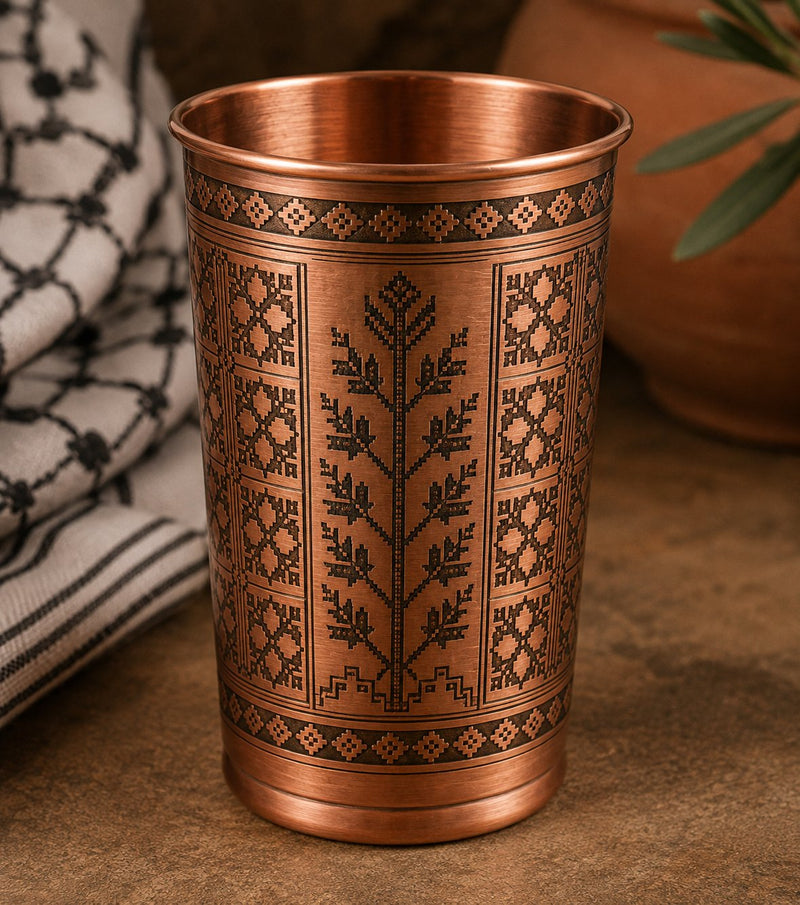
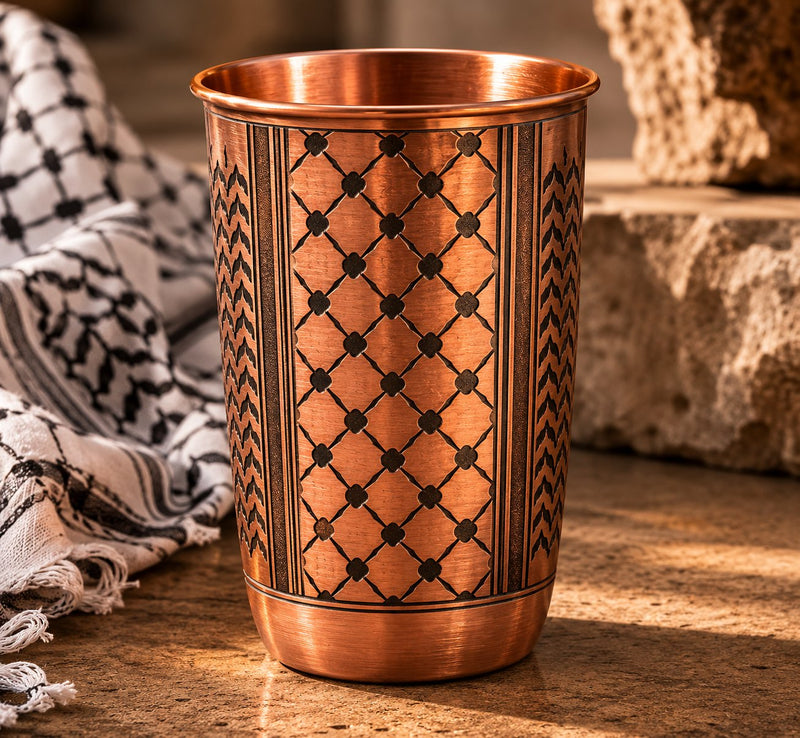
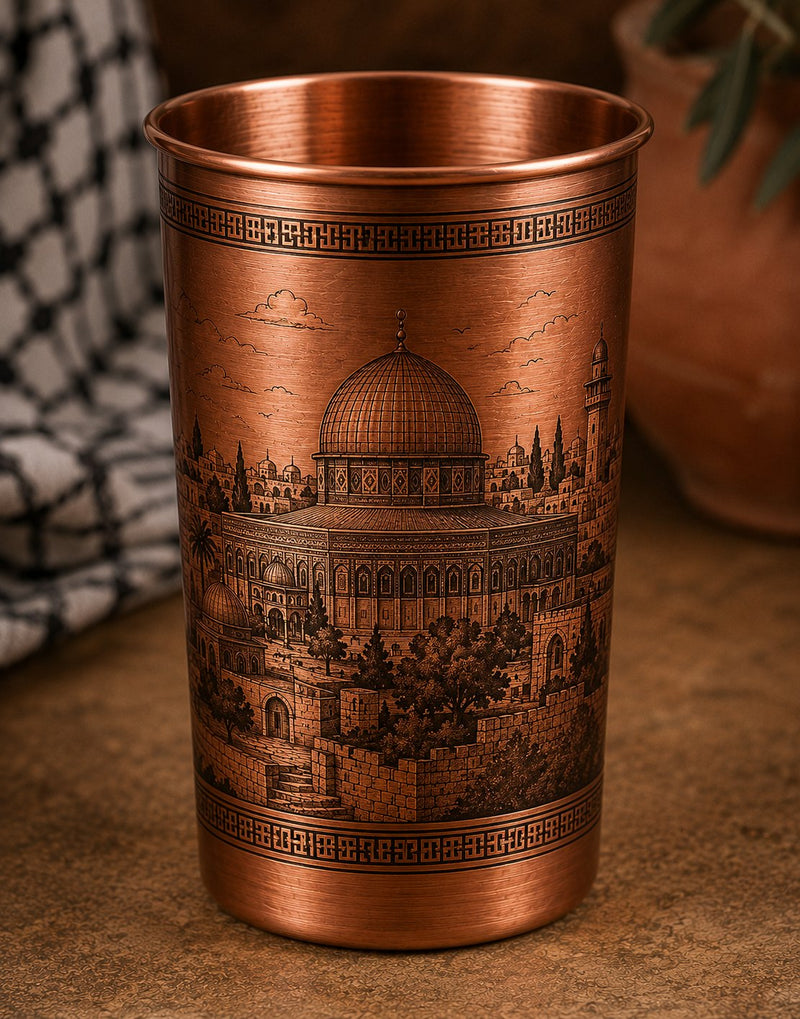
Three patterns, and what each one carries.

Kufiya
The fishnet lattice and the olive-leaf border — the pattern that became a national signature.
Read it →
Tree of Life
The cypress worked in counted cross-stitch. The oldest motif in Palestinian embroidery.
Read it →
Quds
The Old City, the dome, the terraces — engraved as one continuous view.
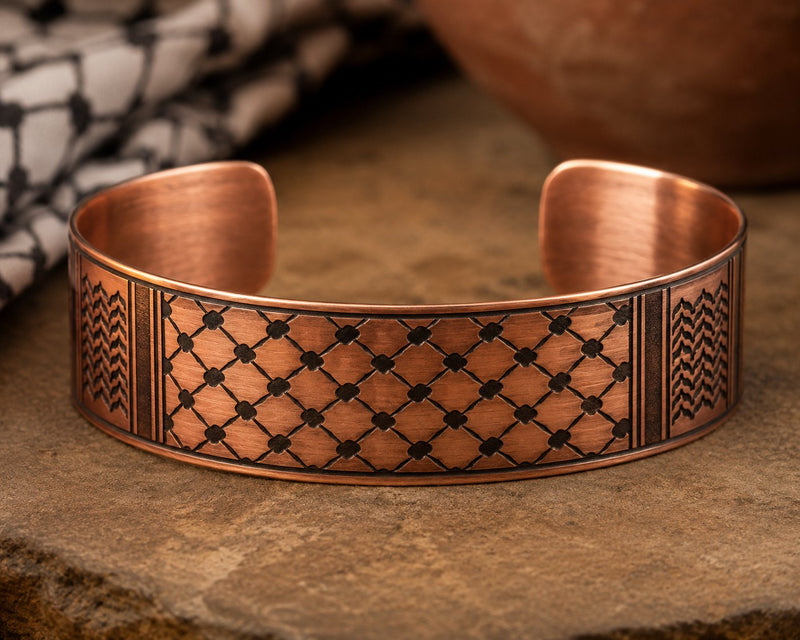
Read it →The Quds Cuff

The whole Old City, closed in a circle, so there is no beginning and no end to it.
The skyline runs the full circumference — walls, dome, minarets, the olive terraces climbing out of frame on both sides. Below it, a band of eight-point stars taken from tatreez.
A sabil is a fountain built into a wall so any stranger could drink.
Endowed as charity, kept by the city, free to anyone passing — of any faith or none. Jerusalem still has them. One of them stands on the Haram al-Sharif within sight of the dome engraved on these cups.
A sabil was free water. So this is not a marketing programme.
A percentage of proceeds funds clean water access in Gaza and the West Bank — filtration units, well repair, and tanker deliveries through vetted local partners. It is printed on your receipt, and we publish where it went.
We do not round up at checkout, we do not ask you to add a donation, and we do not print it on the packaging. It comes out of our margin, not your basket.
A short letter, when there is something worth saying.
New engravings, the story behind each motif, and where the water money went. Roughly monthly. Never more.